The construction industry has been severely impacted by this shortage, creating bottlenecks in major transportation, housing, and energy projects.
Skilled trades, including bricklayers, formworkers, and steelfixers, are still in high demand across major infrastructure projects. This is placing pressure on schedules and budgets, increasing management complexity.
But rather than focusing solely on worker availability, many project managers are using more efficient construction methods to enhance productivity and reduce on-site challenges.
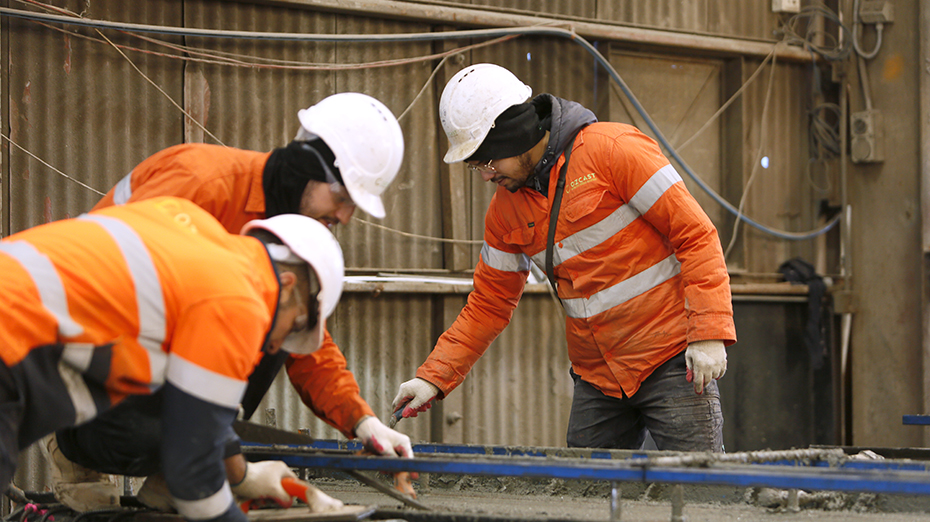
Ozcast supports this approach by taking labour-intensive processes to a controlled environment. We manufacture precast concrete elements off-site so teams can simplify their work, enhance reliability, and boost momentum, especially during periods of industry-wide labour restrictions.
The Current State of the Construction Labour Market
Experts describe it as the “perfect storm”: a combination of a post-COVID infrastructure boom and migration lags, creating high demand amid low supply.
Infrastructure Boom Post-COVID
Everything paused during COVID, especially construction and infrastructure projects. But after vaccines became available and lockdowns were lifted, the world slowly returned to normal. Projects resumed with renewed intensity and massive spending budgets. The 2021-22 federal budget allocated more than A$110 billion for over 10 years [2].
Reduced Migration Numbers
A significant reduction in migration numbers has been noted, particularly during the pandemic, with border closures seen as a major contributing factor to current labour shortages. The shrinking pool of available workers across the construction, hospitality, and agricultural sectors has created skill gaps and job vacancies.
Other Factors Affecting Labour Shortage
- Fewer Australians are interested in apprenticeships: driven by the younger generation’s preference for university education and a negative perception of trade careers.
- An ageing workforce: experienced workers are retiring faster than younger workers entering these careers, leading to significant gaps.
Project Delivery Impacts
A labour shortage complicates project delivery, especially when multiple trades must work in sequence. Project managers face challenges coordinating schedules and maintaining momentum when resources are stretched thin across projects. These conditions place added pressure on tasks that need flexibility in both planning and execution.
Managing Program Risks
During delays, indirect costs rise, including plant hire and site facilities. To manage this risk, managers are adopting approaches that reduce the reliance on prolonged on-site work, such as formwork and blockwork.
Manufacturing precast off-site allows you to produce critical elements in parallel with site work, maintaining momentum, improving overall costs, and ensuring schedule certainty.
Meeting the Construction Labour Challenge with Smarter Methods
Taking labour off-site is a practical and cost-efficient strategy that many project managers are considering. They follow DfMA or Design for Manufacture and Assembly, a concept that means moving complex tasks, such as formwork, to a controlled environment or factory [3].
Factory Control
At Ozcast, we build precast concrete solutions in a factory under controlled conditions. Our operations are unaffected by the weather or other environmental factors, so orders are completed on time and on schedule.
On-Site Simplification
Precast elements are ready for installation, thereby streamlining on-site activities. Installation teams can focus on safer, more efficient placement and coordination, reducing congestion and improving overall workflow. Project teams can deploy their on-site workers more effectively with this simplified approach.
Weather Independence
Precast concrete production continues year-round, no matter the weather. On the other hand, on-site formwork stops when it rains, greatly affecting project timelines. and overall quality of work.
Program Coordination
Manufacturing off-site helps project managers coordinate better with downstream trades. They have greater confidence in meeting delivery schedules; thus, subsequent tasks can be scheduled without delay. Precast concrete can indirectly reduce disruption and support smoother project delivery times across complex programs.
The construction sector continues to face uncertainty [4], with cost pressures and scheduling issues affecting project delivery. Precast concrete is predictable, helping teams ensure reliable timelines.
Comparing Build Methods: In-Situ, Blockwork, and Precast
Concrete formwork can be accomplished in situ (on-site) using blockwork or off-site using precast concrete elements. Let us compare these.
Scenario A (In-Situ)
In-situ formwork requires a team of on-site workers, each one working 2 to 3 weeks to complete a single element, such as beams, columns, slabs, cladding, and others. Workers, composed of formworkers, steelfixers, concreters, and strippers, form these structures but may pause due to weather conditions.
Scenario B (Blockwork)
Requires bricklayers and labourers to complete construction elements. They mix mud and lay down concrete blocks, which can be slow and time-consuming. Blockwork is usually used in smaller projects and, like in-situ formwork, is greatly affected by weather and environmental conditions.
Scenario C (Ozcast)
When you choose Ozcast, your precast elements arrive ready for installation by a dedicated rigging crew and crane. Large components, such as walls or deck elements, can be installed more quickly than traditional in-situ or blockwork methods.
Simplifying installation and reducing on-site activities allows your team to coordinate trades more effectively, minimise site congestion, and improve overall safety.
The Financial Case: Reducing Preliminaries
Precast concrete may sometimes be perceived as having high upfront costs. However, looking across the full project lifecycle, precast can help managers with overall expenditure by enhancing efficiency and ensuring certainty.
By reducing the duration of labour-intensive on-site work, your team can better control preliminaries such as crane hire, scaffolding, and site facilities, supporting effective on-site coordination.
Quality and Time Certainty with Precast
Precast concrete enables structural elements to be constructed off-site, with critical components manufactured in parallel with site works. This can significantly shorten construction phases and program durations, and provide earlier access for subsequent trades.
Our controlled manufacturing processes and strict quality assurance systems guarantee consistency and accuracy in all our products. Ozcast delivers precast solutions ready for installation, ensuring smoother project delivery and long-term value.
Conclusion
In today’s labour shortage, only projects that embrace ingenious ideas survive. You will never beat the tradie shortage by chasing scarce workers. You persevere by innovating your build method.
By using precast concrete instead of in-situ or blockwork, you ensure speed, good quality, and reliability. You don’t need to stress about the weather, preliminaries, and other challenges that could stall your project.
Contact Ozcast today to find out how we can reduce project risk and get you to the lock-up stage faster.