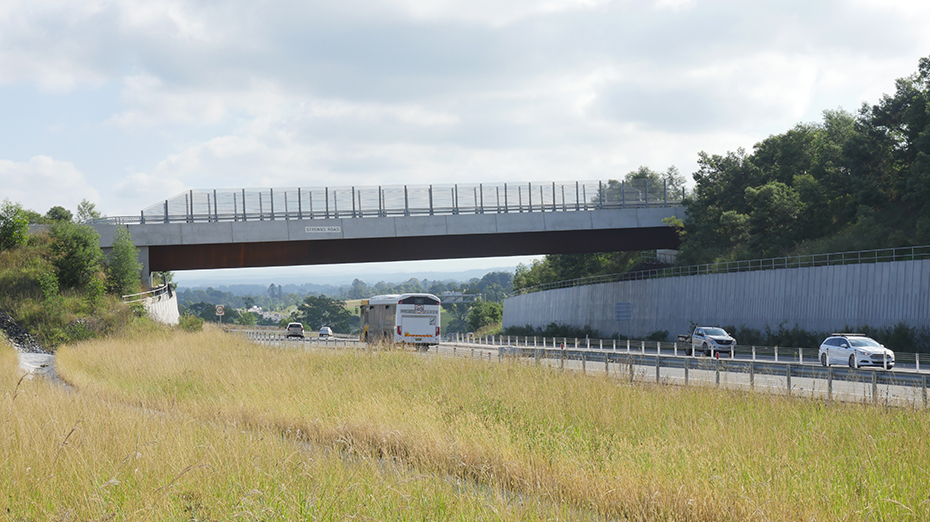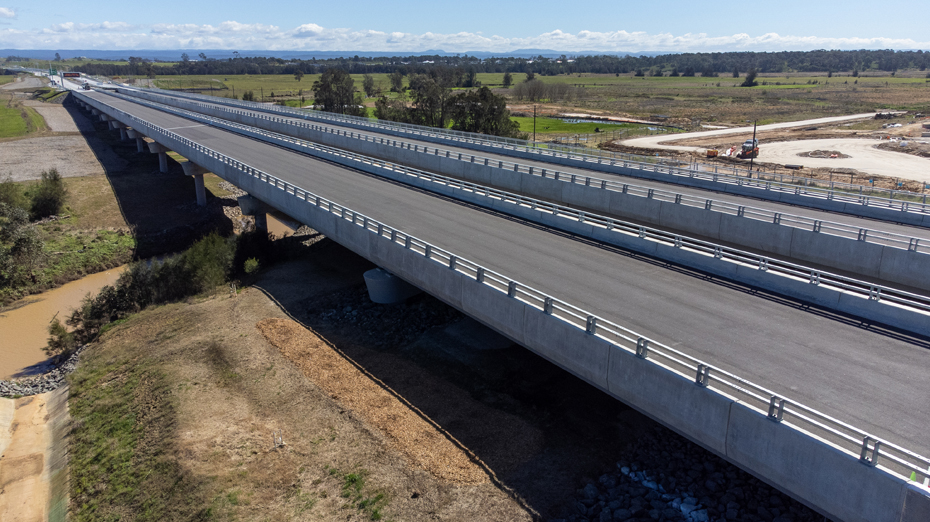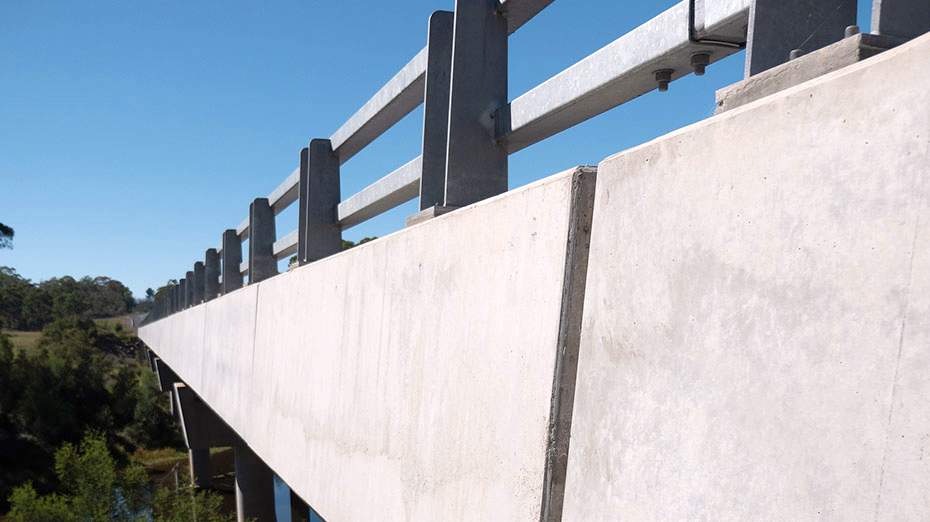
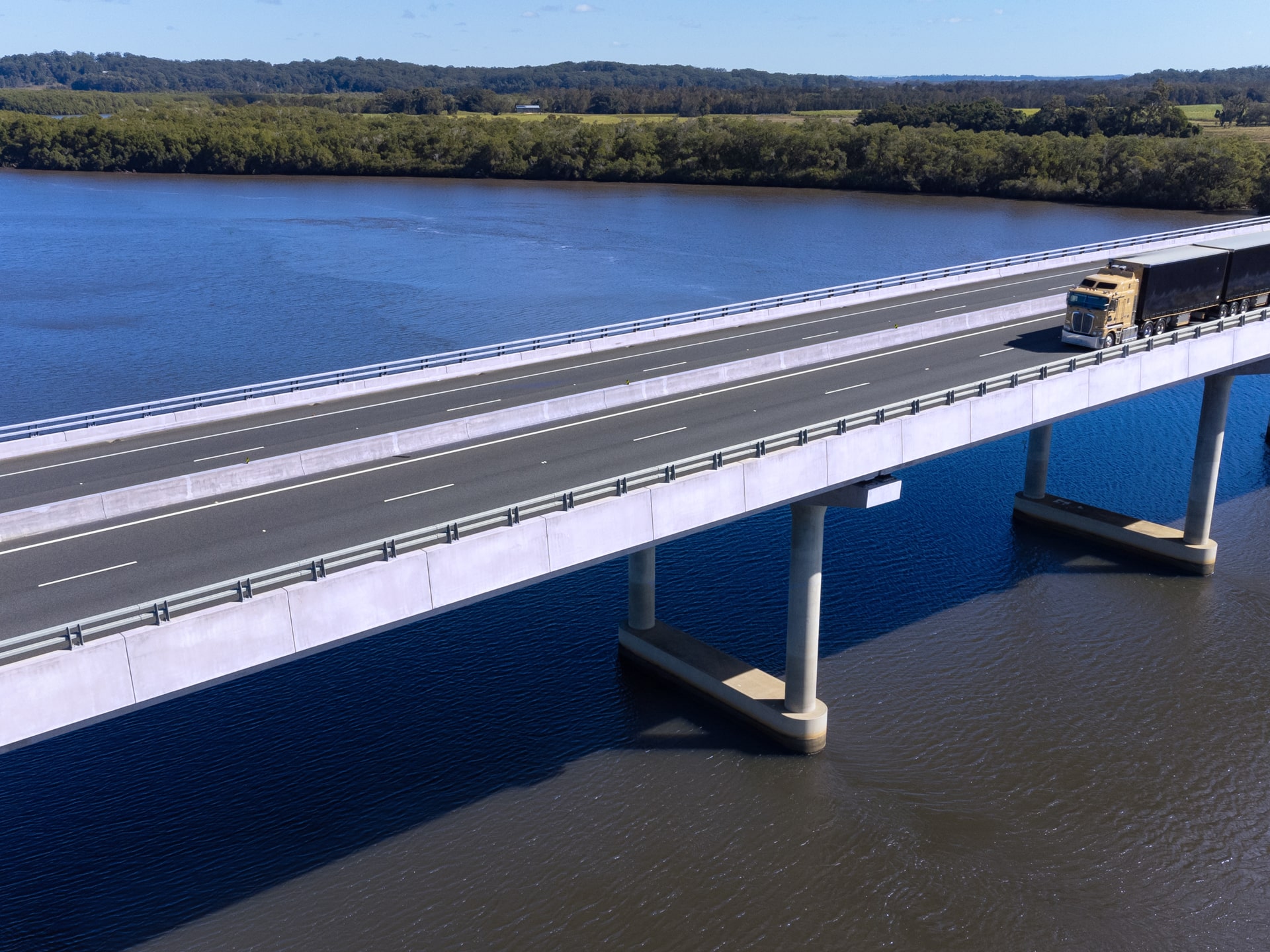
Austroads and AS 5100 standards ensure precision and inform parapet designs. Ozcast Precast, a leading Australian manufacturer of high-quality precast concrete bridge parapets and barriers, comply with these standards, ensuring the safety of vehicles and pedestrians across Australia.
Rigid Barriers: Precast and In-Situ Concrete Systems
Rigid barriers are non-yielding safety systems, designed to stop vehicles with minimal to zero deflection during a crash. These barriers are used in high-risk areas such as bridge decks, elevated walkways, and along high-speed corridors where space constraints and higher consequences of vehicle overrun require maximum containment.
The use of rigid barriers to promote strict safety and performance standards is outlined in Austroads and AS 5100.
In-Situ Concrete Parapets
Rigid barriers may be cast directly on-site or in-situ, using a fixed framework. This process creates a monolithic structure with high mass and crash resistance. In-situ concrete parapets offer long-term durability and easy integration with the bridge deck.
However, construction generally depends on the weather, is labour-intensive, and may extend project timelines because of intensive curing and formwork removal.
Precast Concrete Barriers
This type of bridge parapet barrier is manufactured off-site inside a controlled environment or factory, ensuring consistent quality, accurate dimensions, and compliance with industry standards.
Precast parapets are delivered to the project site and installed using cranes, ensuring minimal traffic disruption and reduced site labour. These barriers are valuable in time-sensitive infrastructure projects.
Overall Best Choice
When it comes to collision performance, both in-situ and precast concrete have high containment levels (N2 to H2) with near-zero deflection. These are effective in containing and redirecting vehicles onto the road. Rigid barriers also have superior secondary damage resistance and need less maintenance compared to other systems.
However, precast concrete parapets are more preferred by project managers for their durability, finish versatility (coloured, textured, or anti-graffiti), and ease of repair or replacement. Precast elements have a streamlined construction process, making them the best option for modern projects that require speed, safety, and great value.
Semi-Rigid Barriers: Steel W-Beam and Thrie-Beam Systems
Semi-rigid barriers are designed to absorb and dissipate crash energy through controlled deformation, making them flexible and containing. Compared to rigid systems, semi-rigid barriers allow limited movement during a crash, thus reducing the impact force to the vehicle and its occupants.
Most semi-rigid barriers are found along highways, approach ramps, and lower-risk parts of bridges where space allows for controlled deflection.
W-Beam Barriers
This type of semi-rigid barrier has one or two corrugated steel rails (W-shaped) attached to steel or timber posts with blockouts or spacer brackets that reduce wheel snagging and enhance impact performance. W-beam barriers are cost-effective and are easy to install or replace, making them great roadside safety barriers.
Thrie-Beam Barriers
This type of barrier has a triple corrugated rail to improve strength and impact absorption. Thrie-beam barriers are installed in areas that require higher containment such as curves, bridge approaches, or in areas where there is a history of high-speed crashes. These barriers offer better redirection than W-beam barriers.
Overall Best Choice
Both systems have common components (steel posts, corrugated beam rails, and blockouts). But when it comes to performance, W-beams have higher deflection ranges compared to stiff Thrie-beams.
These semi-rigid barriers are easy to repair, with damaged sections replaced individually without removing the entire barrier.
Flexible Barriers: Wire Rope Safety Systems
Flexible barriers are composed of tensioned wire ropes attached to steel posts. These can significantly flex during a crash, absorbing impact energy through the tensioning of the wire ropes and bending of posts.
Flexible barriers are not typically used as parapets because of their high deflection. Instead, these are installed on bridge approaches, roadside run-off areas, and median strips to redirect vehicles and reduce crash severity.
Wire rope systems work by slowly decelerating the vehicle over a long distance, reducing the forces experienced by the occupants. These reduce the likelihood of a rollover or secondary collisions as energy is absorbed and distributed as the rope flexes and the post deforms.
Advantages
Wire rope barriers have lower installation costs compared to other systems. These offer high visibility, maintaining driver sightlines. This type of barrier is also easy to repair, as damaged sections can be quickly re-tensioned or replaced.
Disadvantages
Wire rope barriers have high deflection distances; thus, they need wide clear zones. It is not suitable for confined bridge deck edges or elevated structures. In high-impact areas, these barriers need to be maintained frequently to ensure vehicle safety.
When it comes to bridge safety, wire rope barriers are usually installed along approach zones. When installed with proper offsets and terminal treatments, wire rope barriers may be an effective and economical solution to prevent run-off-road incidents.
Combination Barriers: Concrete Base with Metal Top Rail
Combination barriers come with a concrete base or upstand, with a metal handrail or top rail. These are common on bridges with pedestrian walkways, shared paths, or viewing decks where vehicle containment and pedestrian safety are critical.
The concrete base provides a strong, impact–resistant barrier that can redirect vehicles. At the same time, the metal top rail adds height for enhanced safety. Combination barriers maintain open sightlines for pedestrians and cyclists, a great solution for urban bridges with scenic environments.
Benefits of Combination Barriers
Combination barriers offer high crash resistance, enhanced aesthetics, and improved transparency for pedestrians. The materials and connection systems for these barriers are carefully selected to ensure durability and strength.
Plates are often embedded into the concrete base during manufacturing, which allows the metal rail to be attached later using bolts or mechanical fixings. Combination barriers offer modular assembly and easier maintenance or replacement.
Design and Specification Considerations
When selecting bridge parapets and barriers, engineers must consider various factors to ensure performance and visual compatibility.
Containment Levels
Bridge parapet levels are guided by the Austroads and the Manual for Assessing Safety Hardware (MASH) standards. Ratings include N2 for general traffic, N3 or H2 for higher-risk areas where heavy vehicles or cars with higher speeds pass.
Deflection and Working Width
The deflection and working width vary depending on the system. Rigid barriers provide near-zero deflection with minimal working width. Flexible systems require more clearance due to increased movement during crashes. The right system balances space constraints with energy absorption requirements.
Durability and Maintenance
The barrier material must be selected for corrosion resistance, especially in coastal areas or in environments with high moisture. Consider impact repair cycles as some barriers allow modular repairs (wire ropes or W-beams). Rigid barriers need more extensive restoration processes.
Aesthetic Integration
The barrier must complement the bridge’s overall design. Some of the popular options include textured or coloured concrete, powder-coated steel, and anti-graffiti coatings, which help harmonise the barrier with its surroundings while ensuring functionality and appeal.