Part of fire safety is the use of strong, fire-resistant materials. Architects and engineers meticulously select these materials for use, especially in critical areas of a building, such as walls, ceilings, and floors. By using fire-resistant materials, professionals reinforce the building’s foundation to withstand flames and heat.
Not only are fire-resistant buildings safe and compliant, they reduce fire insurance premiums by lowering the risk of costly damage and claims. Let’s learn more about fire resistance when using precast concrete.
How Precast Concrete Performs in Fire Conditions
Concrete is the most commonly used material in construction due to its strength, durability, and versatility. It is naturally fire-resistant because of these qualities:
Non-combustible
Concrete is composed of natural materials, including cement, sand, and aggregates, which do not burn and are therefore non-combustible. Because of these components, concrete can contain flames and limit the spread of fires.
Low thermal conductivity
It takes a long time for heat to transfer to concrete, making it a great insulator during a fire. Concrete can block heat from penetrating and damaging internal elements, such as electrical lines and water pipes, thereby protecting them and delaying the effects of the fire.
Does not emit toxic smoke or gases
Unlike other building materials such as wood and steel, concrete does not release toxic chemicals or gases when subjected to extreme temperatures. With minimal smoke, people can safely exit the building, and firefighters can enter to put out the fire.
Retains structural integrity even at high temperatures
Concrete will never break or fold, even when exposed to high temperatures. It will maintain its structural integrity, allowing people to evacuate safely and enabling immediate and safe emergency response.
Understanding Fire Resistance Ratings (FRL) for Precast Concrete
Precast concrete is a practical, flexible and efficient construction solution, allowing faster installation times and improving overall project timelines. The BCA describes Fire Resistance Ratings (FRL) for precast concrete to tell how well an element can resist the spread of fire within a building.
FRL is described as xx/yy/zz and expressed in minutes.
- xx minutes for Structural Adequacy
- yy minutes for integrity
- zz minutes for insulation
Let us look at these factors closely:
Structural Adequacy
Structural adequacy is a measure of how long a load-bearing element sustains load when exposed to fire. Non-load-bearing elements do not have this parameter; thus, their FRLs are expressed as -/yy/zz.
Integrity
Integrity is the ability of a construction element to resist flames and hot gases, thereby preventing the fire from spreading to nearby areas and reducing its destructive capabilities. It is the time an element remains in one place without opening up or cracking despite being exposed to extreme heat and surrounding gases.
Insulation
Insulation refers to an element’s ability to resist the passage of heat through it, keeping the other side cold enough to prevent the ignition of combustible materials in contact with it.
Typical FRLs are required for walls, floors, and beams in commercial and residential buildings.
- Floor next above (including floor beams) – 90/90/90
- Roof next above (including roof beams) – 90/60/30
- The lowest storey and the storey above – 90/90/90
This table details the FRL of building elements:
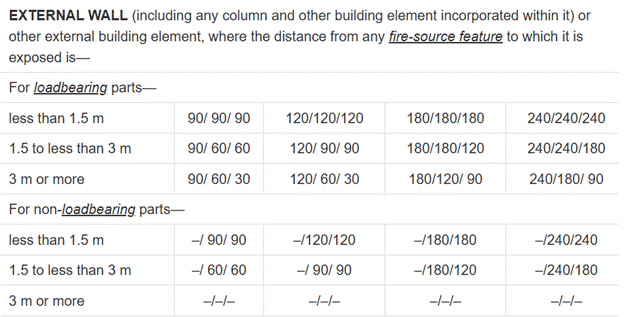
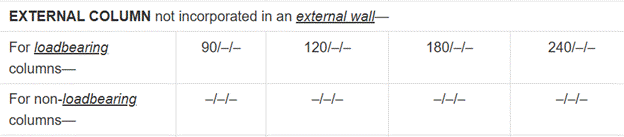
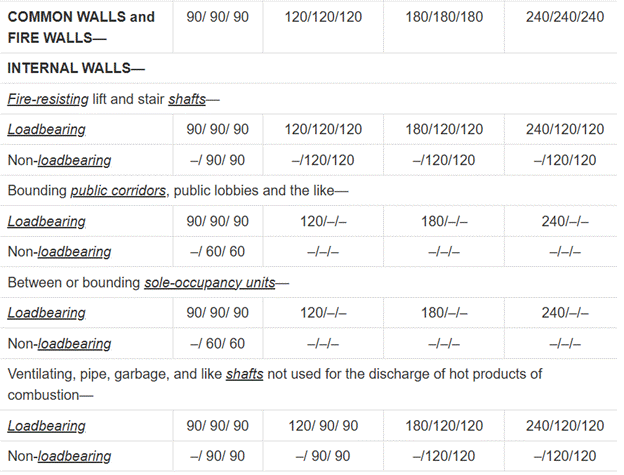
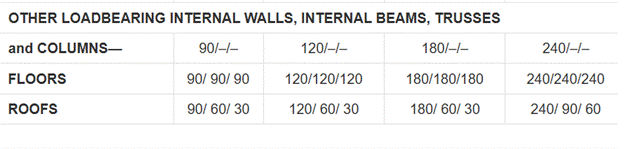
Detailed FRL of building elements. Source: National Construction Code
Ozcast precast concrete elements are tailored to meet FRL requirements, ensuring the quality and safety of all our products. We use only high-quality materials and apply controlled curing methods to ensure FRL standards are met. Our engineering support and efficient FRL documentation demonstrate our dedication to compliance, reassuring our customers and insurers.
Design Considerations for Fire-Resistant Precast Applications
The following are design considerations to develop fire-resistant precast concrete elements:
Wall thickness and cover depth
Adequate wall thickness and concrete cover for reinforcement are critical for achieving high FRLs. Thicker walls and deeper covers support the concrete’s strength and protect the steel from prolonged exposure to heat.
Joint detailing and sealants
Designers must closely consider joint design to ensure fire resistance. Applying fire-rated sealants keeps precast components protected from fire and smoke, thereby preventing the spread through panel gaps.
Placement of reinforcement
Proper placement of reinforcement bars improves fire resistance in precast concrete elements. The AS 3600 provides minimum concrete covers and reinforcement bars to ensure the structural integrity of concrete components during fire.
Integration with other fire protection elements
Aside from the specifications of precast concrete elements, fire resistance also considers the precast’s integration with other components, such as insulation, barriers, and other systems. Collaboration with engineers ensures a seamless transition between these materials for continuous fire protection.
Compliance & Testing Standards in Australia
AS 3600
The AS 3600 is the Australian Standard for the design and detailing of concrete structures. This includes FRLs for walls, beams, columns, and floors. The AS 3600 specifies minimum requirements, cover to reinforcement, and construction practices to achieve FRLs.
NCC/BCA fire requirements
The NCC, formerly the BCA, provides mandatory fire safety requirements for buildings. This includes FRLs for structural elements and fire separation between spaces. Following the NCC ensures life safety, safe evacuation, and low property loss during a fire.
Fire testing protocols in Australia
Fire testing standards, such as the AS 1530, assess how building materials and systems perform in a controlled fire. Various building products are subjected to fire to determine their structural adequacy, integrity, and insulation performance. Passing fire tests leads to product certification.
Our rigorous manufacturing controls, regular testing, and compliance with Australian standards ensure the quality of every precast element we produce. We provide thorough documentation, compliance certificates, and fire resistance reports for all our precast products.
How Ozcast Supports Fire-Safe Precast Solutions
High-quality materials and controlled curing
At Ozcast, we only use top-quality materials to create every precast element, ensuring strength, durability, and consistency. Our manufacturing facility operates in controlled conditions to enhance the performance of precast concrete, prevent defects, and provide reliable fire-resistant qualities.
Customisation for FRL-specific projects
We offer customised solutions tailored to projects requiring specific FRLs, ensuring compliance with AS 3600 and NCC. Our in-house engineering and design team collaborates closely with clients to develop elements that meet both structural and safety requirements.
Engineering support and FRL documentation
Our expert engineers provide support to clients throughout the entire manufacturing process. From design to detail, we provide comprehensive FRL documentation, including test data, compliance certificates, and calculations, ensuring a seamless approval process.
Need custom precast concrete for your next project? Contact Ozcast to learn more.